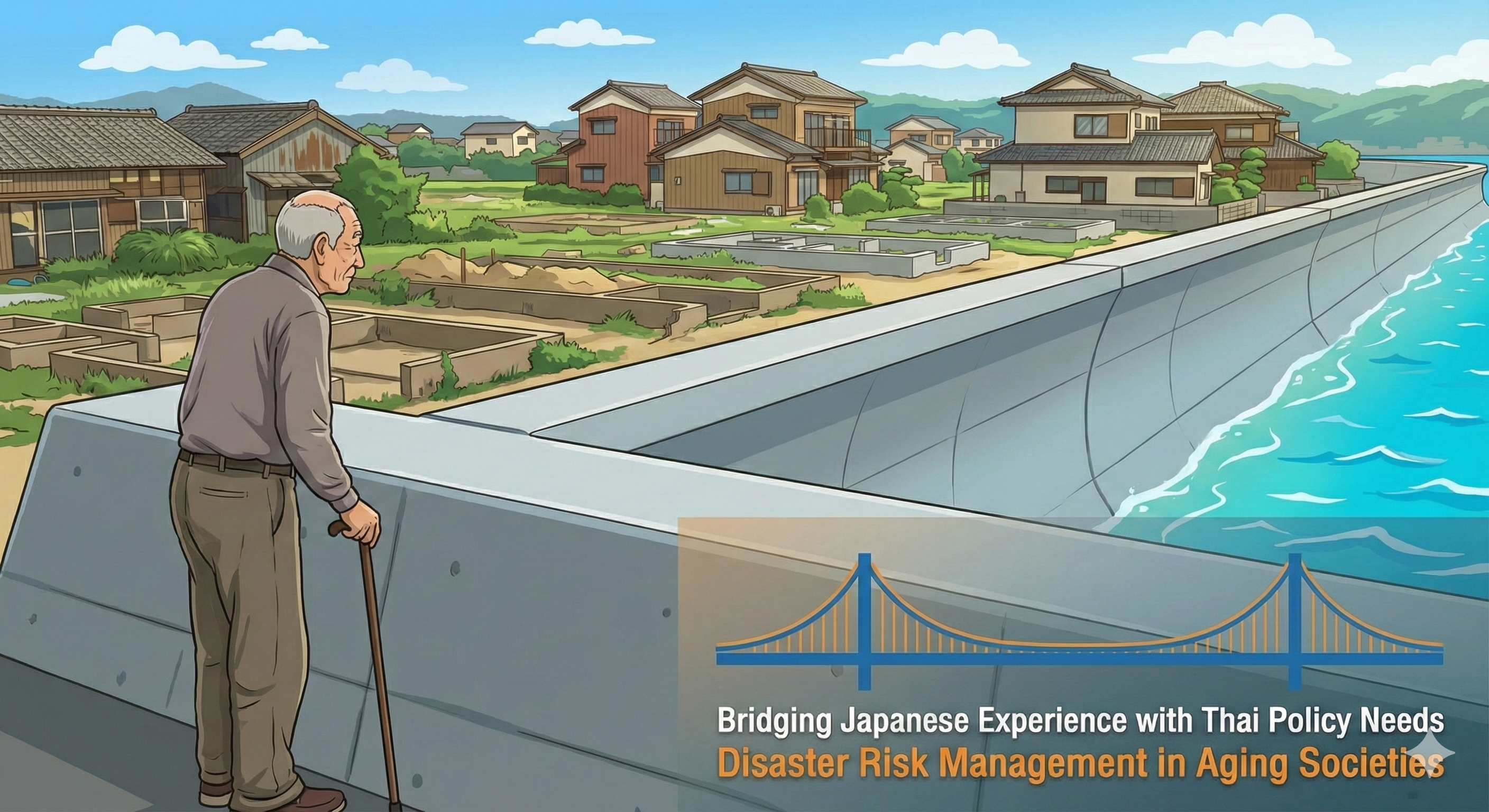
Disaster Risk Management in Aging Societies
East Asia faces a convergence of risks: rapid population aging colliding with intensifying climate disasters. Thailand is hurtling toward the demographic crisis Japan has already faced. Japan's recent history serves as a critical "crystal ball" for Thailand's future.
Theoretical Framework
Conventional wisdom suggests that more aid equals better recovery. Bates & Peacock's Theory argues that disaster recovery merely accelerates a community's pre-disaster trajectories.
Key Insight
Infrastructure without people is not resilience. Investing billions in seawalls for a town that will be empty in 20 years represents a fundamental policy failure.
Evidence Base
Evidence from the 2011 Great East Japan Earthquake (GEJET) and the 1993 Okushiri Tsunami demonstrates that engineering solutions alone cannot sustain shrinking communities.
Research Gap
Thailand has yet to benefit from Japan's hard-won experience. This project constructs the first systematic policy bridge between the two nations' disaster–aging nexus.
Following the 1993 tsunami, Okushiri Town received massive reconstruction funding. Yet its population continued to decline. The data below reveal a stark disconnect between financial investment and demographic reality.
Source: Okushiri Town Recovery Data
Source: National Census of Japan
The proportion of residents aged 65+ across key disaster-affected cities rose sharply from 1990 to 2020, compounding community vulnerability to future hazards.
Figure: Percentage of Population Aged 65+ (1990–2020) · Source: Statistics Bureau of Japan
Source Sites
Knowledge
Transfer
Target Sites
Research site: Coastal communities of northeastern Japan.
Field notes, progress reports, and findings from the research team.
No posts in this category yet.
Use the ✎ button at the bottom-right to add your first post.
Enter the admin password to manage blog posts.
Incorrect password. Please try again.
No posts yet. Add your first post above!